
Blending AI and Experiential Learning
We live in a world that is consumed with images, video, processes, reviews, and text that are autogenerated through AI prompts. It has become increasingly difficult to decipher what’s “real” and what’s fabricated. One almost needs to assume that content is AI generated unless it can be seen . Artificial intelligence is a convenient tool. Speaking from personal experience, it has definitely lightened my workload and helped me learn new skills and strategies at a much higher rate.
But also speaking from personal experience, it can all feel very overwhelming and even stressful. It’s easy to adopt a Luddite mentality and respond with fear or avoidance in the face of a never-ending stream of new tools. Perhaps, however, there is a better way.
Luddites are often thought of as a group of people who are anti-technology. One post by writer Samantha Green describes this mentality as “someone who is reactive, who buries their head in the sand at the prospect of change.” Green mentions that is not really an accurate description of Luddites. Instead, she argues that the Luddite narrative stems from the Industrial Revolution – a time when factories and machines began to automate jobs and processes that were previously done by hand. The Luddites fought for improved working conditions, the ability to earn a living wage, and to support their families.
Rather than being reactive to change, the Luddites were proactive: they saw the impact these industrial machines would have, not just on economic progress, but on the lives and well-being of their communities.Luddites were protesting changes they thought would make their lives much worse, changes that were part of a revolution being celebrated as progress. They were fighting for economic justice, not against progress itself.” (Green)
Our academic world faces a similar struggle. Our students have the convenience of tools and systems that were never previously available, as they can generate papers, infographics, and presentations in seconds. It is important to discern the impact of these tools on the learning process and assignments, as well as consider whether we should embrace or avoid AI.
While there is not a clear cut answer to AI, one idea could be to blend AI tools and processes with Experiential Learning (EL).
In a previous tech blog post, ITG Jeff Muday, does an excellent job describing EL.
“Experiential learning is a teaching and learning approach that focuses on hands-on, real-world experiences rather than traditional classroom instruction. The goal of experiential learning is to help students develop practical skills and knowledge by engaging in activities, projects, and problems that require them to apply what they have learned.” (Muday)
Overuse of learning through AI tools and strategies leads one to question what is true and real. It can rob learners of experiences and struggles that need to take place during a learning cycle. However, EL can provide authentic opportunities to process difficult content and reach important failure points. These failure points provide a chance for students (and instructors) to persevere through a learning process and find a solution.
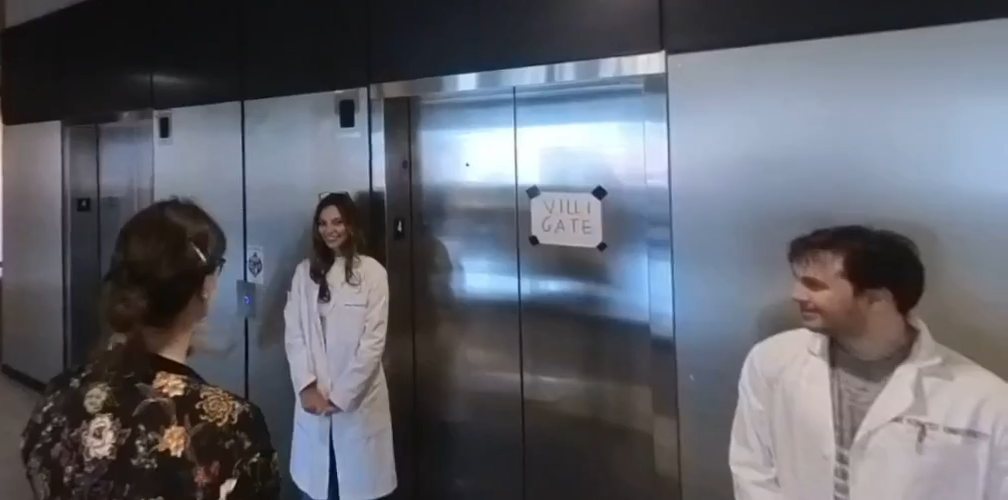
As an ITG at the Wake Downtown campus, I have had an opportunity to observe EL firsthand. For example, in Professor Jes Bolduc’s Biochemistry I class (BIO/BMB/CHM 370), students learn how the body utilizes carbohydrates for energy by tracing the metabolic pathway of a carbohydrate from ingestion to cellular use. Rather than approaching this material solely through traditional instruction, students engaged in an interactive, embodied learning experience by staging a play that transformed the Wake Downtown building into a model of the human body.
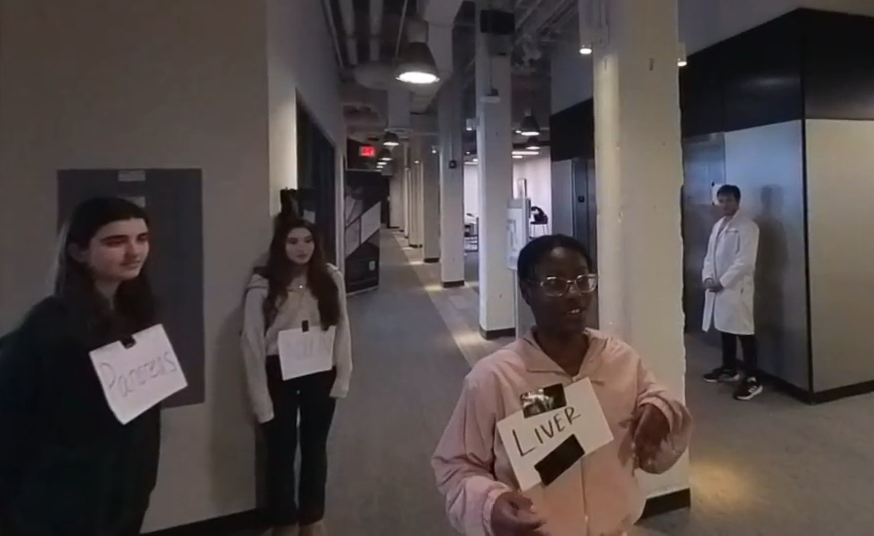
Dr. Bolduc created a prompt within ChatGPT to generate a script/storyboard for their project. Roles were assigned and they moved throughout the Wake Downtown campus to act out the “play.”
The performance was recorded using a 360-degree camera. I had the opportunity to assist Dr. Bolduc with a virtual reality video of the performance, offering an immersive, first-person perspective that allows viewers to move through the pathway of carbohydrate breakdown themselves.
Beginning in the “mouth,” on the fourth floor, complex carbohydrates—represented by two students holding hands—were broken apart by the teeth and the enzyme Amylase (students cast themselves in these roles). From there, the molecules traveled through the building, mirroring the physiological journey of digestion and absorption, until arriving in the biochemistry teaching laboratories. One side of the space represented a muscle cell undergoing glycolysis and prepared to take up glucose for immediate energy, while the other represented the liver, where excess glucose could be stored for later use.
Through this hands-on, spatial reenactment of a core biochemical pathway, students developed a deeper and more intuitive understanding of carbohydrate metabolism while actively engaging with the material.
Motivated by the success of the experience, students also sought to share it beyond the classroom.
This instance shows a compelling example of how AI and EL can blend together to create a unique and authentic learning experience. ChatGPT provided the framework and script for the play. Students however were active participants through acting out the roles and were later immersed in viewing the process through a 360-degree video platform.
Artificial intelligence will become increasingly powerful in the days to come, technology will advance much faster than can be imagined, and these tools can be used to empower students to direct their own understanding through experiential activities. As a result, it is important to consider how AI can be used in the teaching and learning process to engage and empower students.
Citations
Green, Samantha. 2025. “Guest Post — Fear, Learning, and Luddites: Opportunities to Lead the AI Revolution.” The Scholarly Kitchen, August 5, 2025. https://scholarlykitchen.sspnet.org/2025/08/05/guest-post-fear-learning-and-luddites-opportunities-to-lead-the-ai-revolution/?utm_source=chatgpt.com
Muday, Jeff. 2024. “The Road to Experiential Learning.” Instructional Technology Group, February 19, 2024. https://itg.wfu.edu/2024/02/experiential-learning/
Categories: Tech Tip